86-592-5659128 (to8016)
anna@xmydx.com English
 Deutsch
 español

20 YEARS Silicone manufacturer
86-592-5659128 (to8016)
anna@xmydx.com
20 YEARS Silicone manufacturer



2026-11-06
Short answer: A custom collapsible container typically samples in 3–7 days and produces in 5–30 days, with MOQ from 100–2,000 pcs depending on size, lid type and colour. Two things decide whether the product works: the wall geometry (how it folds and whether it comes back) and the lid seal (whether it leaks in a bag). Everything else is styling.
This guide covers how the wall is designed, why the lid is where complaints come from, what to test, and how volume drives tooling.
• The wall is the product. Step count, wall thickness and the radius at each fold decide whether the container collapses smoothly and recovers its shape.
• Silicone has compression memory, but it is not infinite. Repeated folding at the same line eventually leaves a crease; the fold radius is what delays it.
• The lid is the leak point. A gasket that is too thin leaks; one that is too thick makes the lid hard to close, which customers read as "broken".
• Mixed materials mean mixed compliance. If the lid or rim is PP, it needs its own food-contact declaration — the silicone report does not cover it.
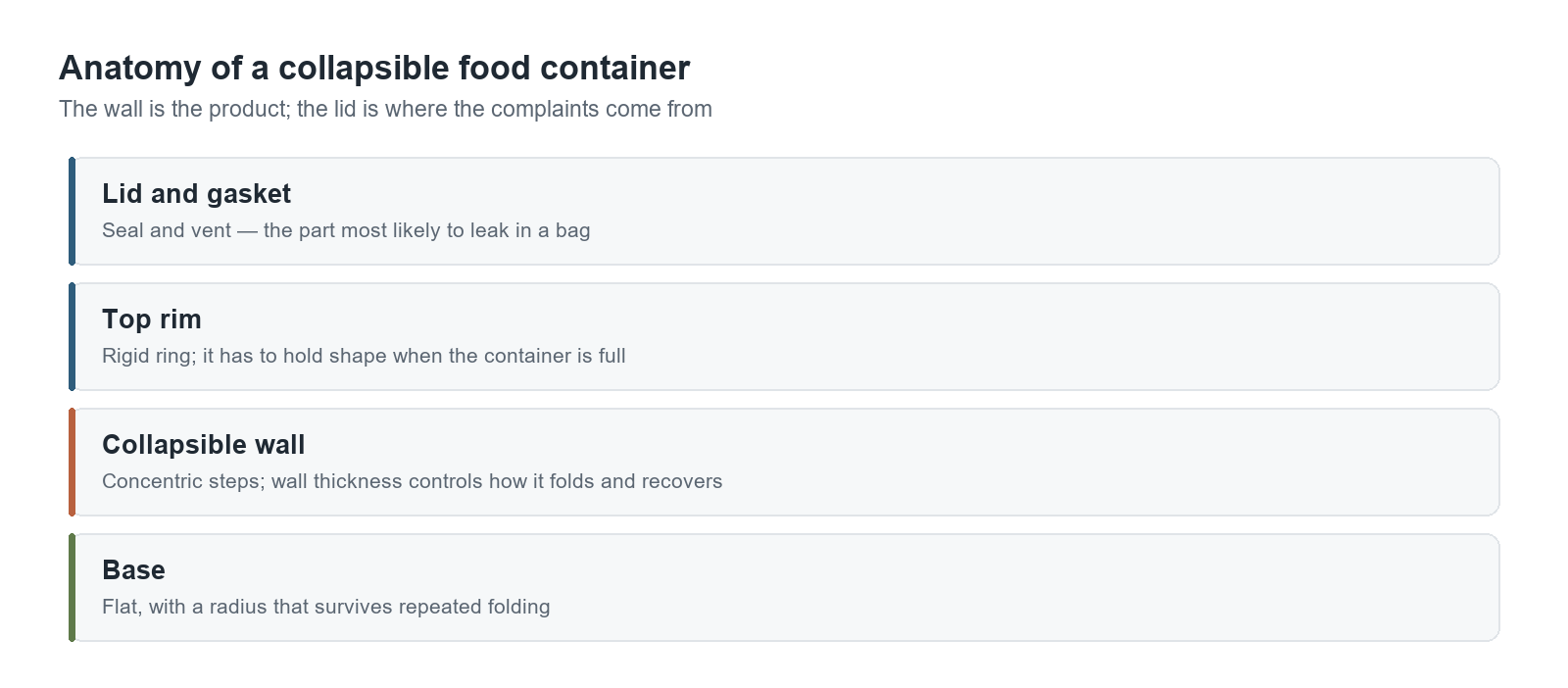
Figure 1. Four functional zones — the lid and the fold radius carry most of the risk.
The product solves one problem: storage volume that is not needed for most of the day. A 1,200 ml container that collapses to a third of its height fits in a bag, a drawer or a camping kit that a rigid box does not.
That gives three distinct buyer groups, and they specify differently:
• Meal-prep and office lunch — leak resistance and microwave safety matter more than collapsed height.
• Travel and outdoor — collapsed height and lid retention matter most; weight is secondary.
• Home storage and freezer — volume accuracy and stackability matter, plus a lid that survives being frozen shut.
Selling one SKU to all three usually means a compromise that satisfies none of them. Most successful ranges split by use, not by size alone.
|
Zone |
Function |
Design note |
|
Lid and gasket |
Seal and vent |
Gasket thickness and shore hardness set the closing force |
|
Top rim |
Rigid ring that holds the opening |
A soft rim makes the container collapse while you fill it |
|
Collapsible wall |
Folds and recovers |
Step count, wall thickness, fold radius |
|
Base |
Sits flat, survives folding |
Base radius must not concentrate stress at the corner |
The wall is a series of concentric steps. Each step is a fold line, and each fold line is a fatigue point. Fewer, larger steps are easier to mould and cheaper to tool; more, smaller steps collapse flatter but concentrate stress.
A practical rule from the toolroom: the fold radius should be at least the wall thickness. Below that, the material is being bent rather than folded, and the crease appears after a few hundred cycles instead of a few thousand.
Three failure modes account for most returns in this category:
1. Leak at the gasket. Usually a gasket that is too thin, or a groove that is too shallow to keep it in place when the lid is closed at an angle.
2. Lid will not close. The opposite problem — too much interference, often introduced when a gasket compound is changed without re-checking the closing force.
3. Vent does not vent. A sealed container going from freezer to microwave builds pressure. A vent that is too small pops; one that is too large leaks in a bag.
A leak test is not optional, and it should be run the way customers use the product: filled, closed, shaken, inverted, and left on its side for a defined period.
|
Volume |
Servings |
Typical use |
Note |
|
500 ml |
1–2 |
Lunch boxes, meal prep, office catering |
Easiest to seal; smallest tool |
|
800 ml |
2–3 |
Leftovers, travel, camping |
The volume format for most ranges |
|
1,200 ml |
3–4 |
Batch cooking, freezer, pet food |
Needs a thicker wall or rigid frame to stay stable when full |

2F/YISHENG BUILDING,1ST INDUSTRIAL ZONE,DIANQIAN,HULI DISTRICT,XIAMEN CITY,CHINA
86-592-5659128 (to8016)
+86-592-5785493
+86-13850076578
© 2016 XIAMEN YIDEXIN SILICONE RUBBER INDUSTRIAL CO.,LTD Todos los derechos reservados dyyseo.com
Online Contact
 86-592-5659128 (to8016)
 anna@xmydx.com
 +8613606037597+8613850076578
top